
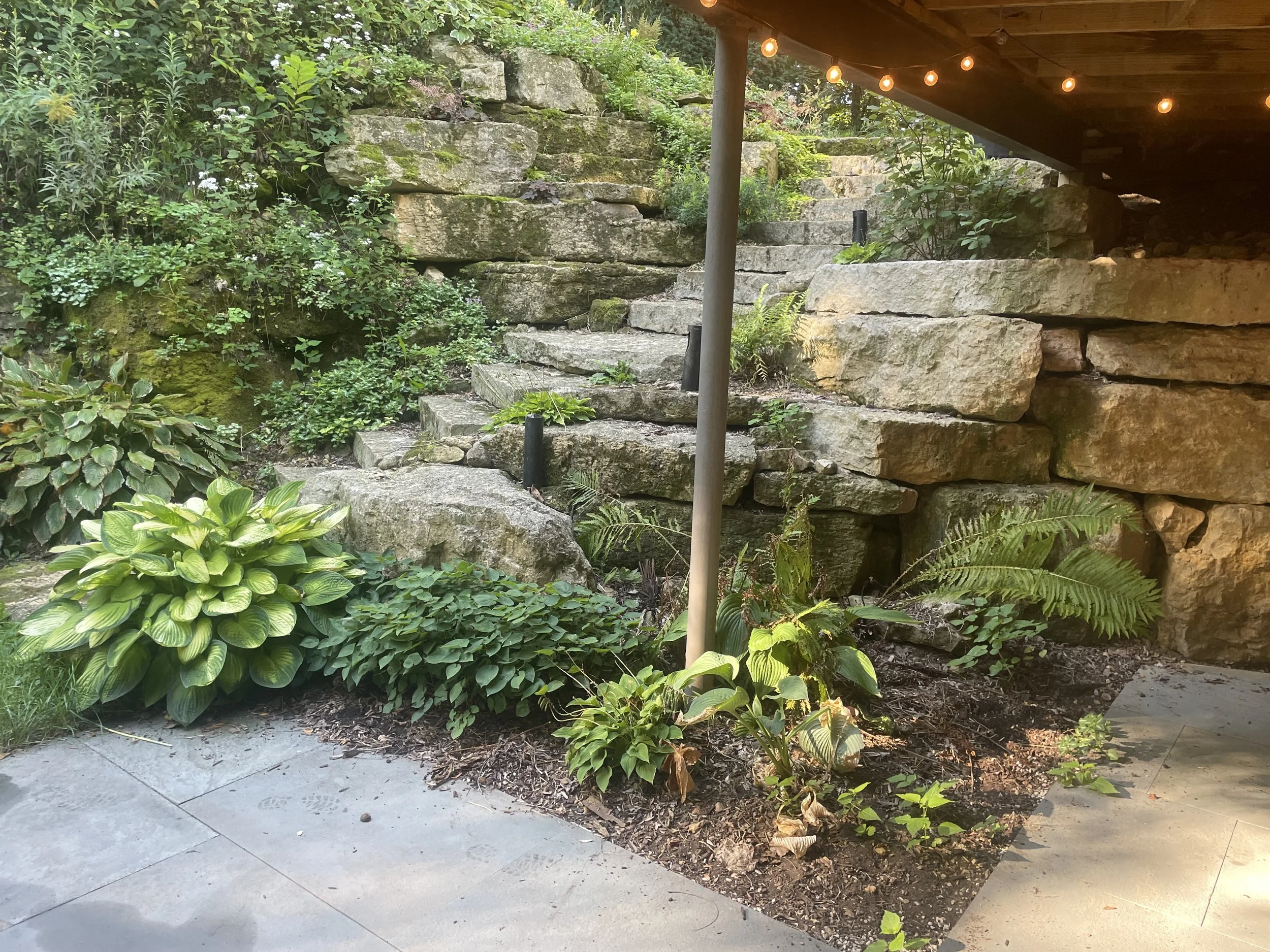
Thinking about replacing your front steps or rebuilding an old landing?
If you're in the Madison, WI area, you’ve probably seen step systems made from concrete blocks- also called CMUs (concrete masonry units). They're inexpensive and easy to find at big box stores. But when it comes to outdoor steps that last, especially in a freeze-thaw climate like ours, they fall short.
Here’s why we don’t use them- and what we recommend instead for long-lasting, code-compliant, and beautiful hardscape steps.
1. CMUs Shift More—And Fail Faster
Step assemblies made from CMUs often use dozens (or even hundreds) of small pieces glued together. Each one becomes a point of weakness when the ground shifts- which happens often during Wisconsin winters.
Common issues with CMU steps in our climate:
Loose or uneven steps
Failing adhesive joints
Cracks or crumbling edges
Tripping hazards
Repeated, costly repairs
By contrast, a single large slab—whether it’s natural stone or cast concrete—stays put and withstands movement much better.
2. Fixed Block Sizes Make Code Compliance Difficult
One of the biggest problems with CMU step systems is that they’re not flexible enough to meet building code.
Most concrete blocks and caps come in set sizes like 3", 4", or 6". That sounds convenient- until you try to build a staircase and realize the riser heights don’t add up.
Residential step code requires:
Step risers between 4" and 7¾"
Consistent height (less than ⅜" variance between steps)
Tread depth of at least 10"
Trying to make that work with off-the-shelf blocks often leads to:
Steps that feel awkward or uneven
Violations of local building code
A stair system that doesn't fit the actual grade of your property
That’s why we custom design each step assembly based on the site and then custom cut large-format materials to get the exact riser heights and tread depths needed—code-compliant and visually clean.
3. Freeze-Thaw Cycles Destroy CMUs
Madison winters are brutal on porous materials like CMUs. These blocks absorb water, and when that water freezes, it expands—causing internal damage that worsens over time.
Even when rated for outdoor use, CMUs are prone to cracking, flaking, and adhesive failure. It’s one of the top reasons clients call us to replace their failing steps after just a few years.
4. Winter Maintenance Is More Difficult
CMU steps have a lot of joints and seams, which means:
Water gets trapped
Ice builds up unevenly
Snow is harder to clear
On top of that, salt and chemical deicers should never be used on CMUs or natural stone. Salt breaks down both the block and the adhesive, leading to faster failure. We recommend sand or calcium magnesium acetate instead- but smoother surfaces like large stone treads make winter care much easier overall.
5. Our Preferred Approach: Custom-Cut Stone or Precast Treads
Rather than building around the limitations of modular blocks, we take a smarter approach:
Natural stone slabs (like limestone or bluestone)
Precast concrete treads cut to size
Custom riser heights based on actual site grade
This allows us to create step systems that are safer, better looking, and built to last. Whether you’re replacing a few steps or rebuilding your entire front landing, we’ll help you choose a solution that’s tailored to your space.
Built for Madison Winters. Designed for Real Life.
CMU steps may seem like an easy fix, but in our experience, they’re rarely worth the long-term hassle. Between code issues, winter damage, and maintenance concerns, they just don’t perform in our climate.
If you're planning to replace old steps, rebuild your front landing, or take on any hardscape renovation, we recommend skipping the blocks and choosing solid, lasting materials from the start.